
What is the difference between hand kneading and a dough mixer?
Sep 21,2026
12
In many households in Europe and America, dough kneading is an essential step for making hamburgers and bread. The condition of the dough directly determines whether the finished product turns out well. Essentially, it fully combines flour and water to develop the gluten network. Gluten acts like an elastic skeleton inside the dough, supporting the structure of baked goods.
If kneading is insufficient, gluten cannot stretch fully, resulting in hard, collapsed products with a coarse texture. However, over-kneading will break the gluten and make the dough lose elasticity, which also leads to unsatisfactory results.
Therefore, mastering the proper kneading method and controlling the kneading degree is the foundation of making good flour-based food. Many home cooks wonder whether to keep kneading by hand or buy a dough mixer. Each method has its own pros and cons and suits different scenarios. We can compare and analyze them from multiple aspects.
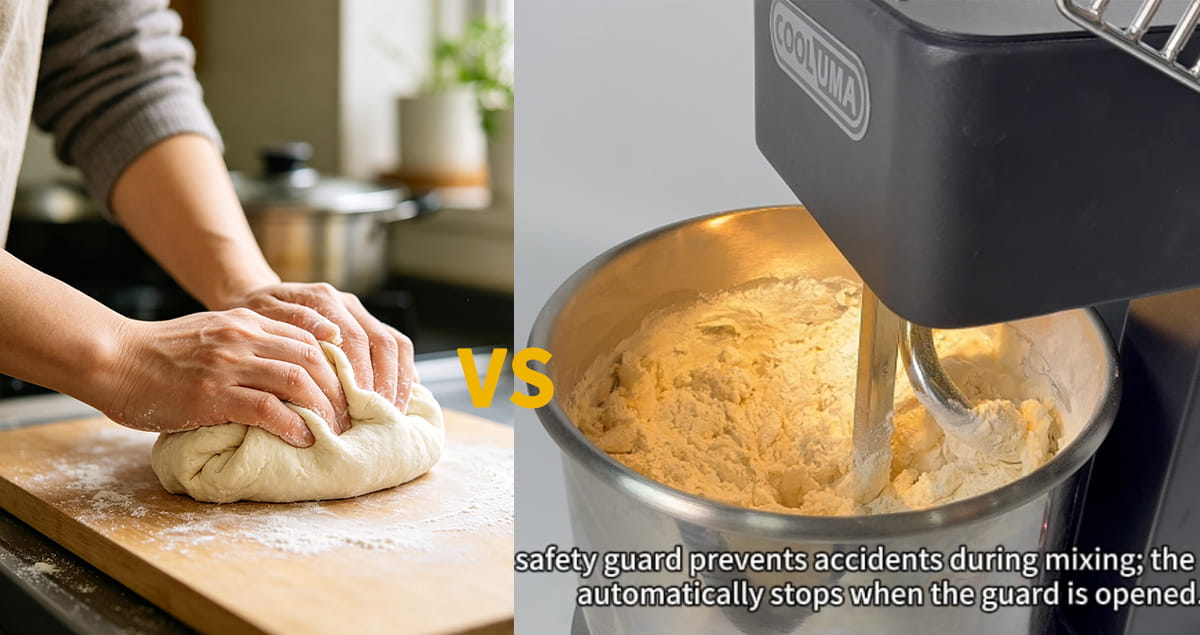
First, effort and physical exertion, which is the most obvious difference between hand kneading and a dough mixer. Hand kneading relies on repeated pressing and folding of the dough with arms and palms. Continuous force is required during kneading. Especially when making bread with high-gluten flour, it often takes more than ten minutes of constant kneading to develop the thin membrane.
Long-time kneading causes noticeable arm soreness and requires physical strength. There is no fixed pressure; you judge the dough’s softness by touch and adjust the kneading pace anytime. In contrast, a dough mixer uses a motor to rotate the mixing hook for automatic continuous stirring. No constant manual pressing is needed. You only need to prepare ingredients in proper proportions and observe the dough condition. Even for bread dough that needs long kneading, the machine works steadily, greatly saving physical strength. It is suitable for people with limited strength or recipes requiring extended kneading.
Second, efficiency and stability of gluten formation, which demand continuous shearing and stretching. Hand kneading pushes, pulls and folds the dough with palms, leading to uneven force and low kneading efficiency.
To reach the development stage required for hamburger buns, hand kneading usually takes 15 to 25 minutes. Besides, the finished dough varies each time due to differences in personal strength and technique. Nevertheless, you can touch the dough at any time to feel its moisture level. Add a little water or flour immediately if the dough is too dry or sticky.
A dough mixer continuously shears the dough with its mixing hook, delivering even and stable force for faster kneading. With the same recipe, a dough mixer can achieve the required gluten state in typically 8 to 12 minutes, producing more consistent dough every time.
Still, machine kneading follows a fixed pattern. Ingredients need precise proportioning upfront. If the water-to-flour ratio is wrong at the start, it is hard to make flexible adjustments while the machine is running.
Third, dough temperature control. Friction during kneading generates heat. Excessively high dough temperature undermines gluten stability and may even trigger premature fermentation. Hand kneading produces little frictional heat, so the dough warms up slowly and temperature is easier to manage. When making temperature-sensitive sweet bread and toast dough, you are less likely to face the problem of dough heating up and fermenting early.
The continuous operation of the mixer motor plus constant friction between the hook and dough creates much heat. Especially in warm environments, the dough tends to heat up quickly. Many people use ice water and chilled flour when making bread with a dough mixer to offset the heat from kneading and prevent premature dough fermentation.
Fourth, cleaning, capacity and flexibility. Hand kneading only needs a mixing bowl. After kneading, cleaning dough off the bowl and hands is simple with no extra attachments. Hand kneading is very flexible for small batches, such as making just 2 to 3 steamed buns, and small amounts of dough are easy to handle. A dough mixer has removable parts including mixing hooks and bowls that need to be cleaned one by one after use.
Meanwhile, dough mixers have a minimum working capacity. If the dough quantity is too small, the mixing hook cannot work the dough properly and kneading quality drops significantly. Dough mixers work better for large-batch flour food preparation at one time. In addition, the machine produces noise; the motor sound is obvious at high kneading speeds, while hand kneading makes almost no noise.
After learning about these differences, you can choose the right kneading method according to your needs.
Hand kneading works better for these scenarios
First, small-batch homemade flour food. For example, making dumplings occasionally or steaming a small number of buns and mantou. The dough portion is small. Hand kneading is simple and convenient, with no need to take out the machine or wash attachments.
Second, beginners testing recipes and adjusting flavours. You can touch the dough anytime during hand kneading and adjust moisture in real time, making it easy to experiment with recipes.
Third, making simple Chinese flour food. Dumpling wrappers and regular mantou do not require well-developed gluten or long kneading, so hand kneading is fully sufficient.
Fourth, limited kitchen space and no intention to add new kitchen appliances.
A dough mixer is more suitable for these scenarios
First, frequent bread and toast baking. These pastries require dough to form a thin membrane. Hand kneading is time-consuming and tiring, while a dough mixer can finish kneading steadily and efficiently.
Second, large-batch flour food production, such as making many mantou and steamed rolls in one go. The machine saves a great deal of physical effort.
Third, frequent preparation of flour food multiple times a week. It saves you from repeated tiring hand kneading over long-term use. Fourth, users with low physical strength, the elderly or people prone to arm soreness. The machine frees your hands.
VONCI states that hand kneading excels in flexibility, convenience and low cost, suitable for small-volume, infrequent Chinese flour food making. Dough mixers feature labour-saving efficiency and consistent dough quality, ideal for frequent baking and large-batch flour food production.