High-speed blender performance and efficiency
Apr 19,2026
340
Some argue that commercial immersion blenders should prioritizehigh throughput, aiming for the maximum processing volume in a given time; others insist on pursuing extreme high-speed blending precision to ensure the texture and nutritional retention of the ingredients. This trade-off between "speed" and "quality" is the core conflict in commercial equipment selection.
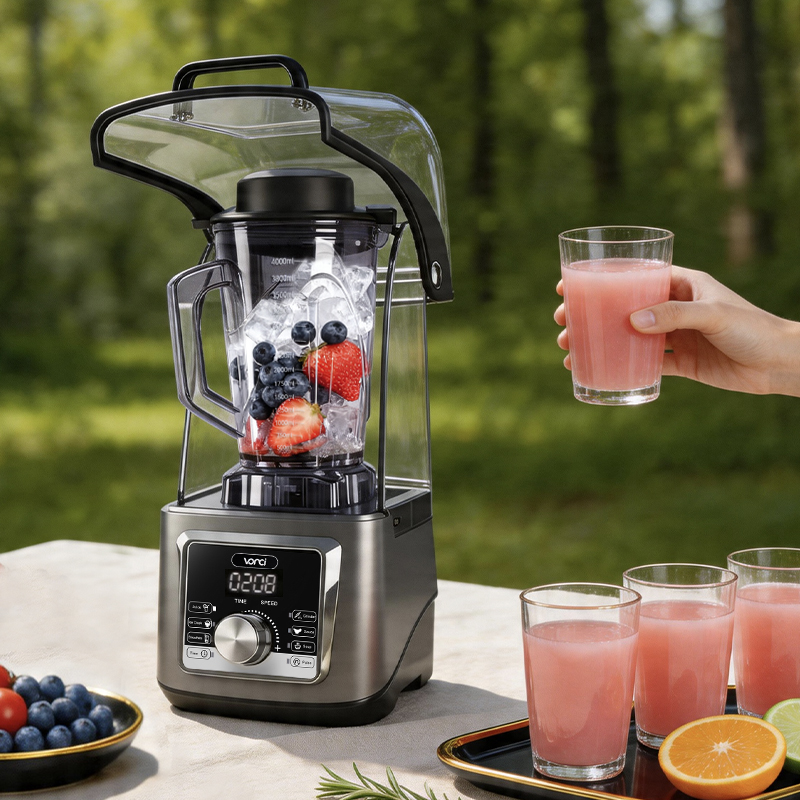
1. Efficiency Driven: Considerations for High Throughput
Commercial kitchens have extremely high efficiency requirements. When selecting an immersion blender, the first step is to evaluate its power density and continuous operation capability.
Motor Design: A high-torque motor is the foundation for ensuring continuous operation under high loads.
Structural Stability: The equipment frame must be able to withstand long-term, high-intensity operation, preventing performance degradation due to vibration.
Ease of Maintenance: Design features that allow for quick blade replacement or cleaning systems directly impact operating costs.
2. Performance Driven: Blending Precision
Simply fast mixing is not enough; commercial applications focus more on the quality of the final product. This requires the equipment to achieve efficient and uniform mixing at a physical level—ideal for processing fruits and similar ingredients.
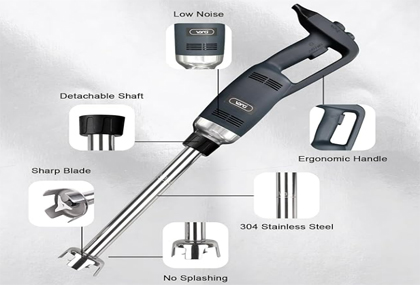
Blade Material and Geometry: Use high-hardness, corrosion-resistant materials, and optimize the blade angle and spacing to achieve uniform mixing (critical for preserving fruit texture and nutrients).
Fluid Dynamics: Design appropriate feeding and mixing paths to ensure that the mixture (such as fruit puree) uniformly contacts the mixing area during high-speed operation.
Temperature Control: For heat-sensitive ingredients like fresh fruits, integrating temperature control can further optimize the texture and retain nutrients.
Conclusion
A successful commercial immersion blender—especially for fruit processing and similar applications—is not a victory of a single metric but a dynamic balance between high-efficiency operation and precise mixing. When making a selection, weigh power, structural strength, and blade design based on your specific application scenario (e.g., smoothies, fruit sauces, high-viscosity fruit mixing).
Frequently Asked Questions (FAQ)
1. Which power is best for high-viscosity ingredients (e.g., thick fruit puree)?
Answer: For high-viscosity ingredients such as thick fruit puree, it is recommended to choose equipment with high-torque output to ensure the motor can continuously overcome viscous resistance.
2. How can maintenance costs be controlled?
Answer: Choose modular design products that allow for quick replacement of wear parts (e.g., blades that handle frequent fruit processing), thereby reducing long-term maintenance costs.
3. How is food-grade safety ensured, especially for fruit processing?
Answer: Ensure that all parts in contact with food (such as blades and mixing containers) use food-grade materials and feature a structure that is easy to clean—critical for preventing fruit residue buildup and ensuring hygiene.
4. What advantages does it have in terms of noise control?
Answer: Advanced vibration damping technology and optimized impeller design can effectively reduce operating noise, making it suitable for commercial kitchens with noise restrictions.
5. What keywords help in searching for this type of equipment (for fruit processing)?
Answer: Searching for keywords such as "commercial immersion blender selection," "high-power fruit blender," "food-grade mixing equipment," and "fruit processing blender" can help you find the most suitable solutions.