
Standard Operation and Maintenance of Bread Dough Mixers
Jun 24,2026
531
Also commonly referred to as dough kneaders or dough beaters, bread dough mixers are core pieces of equipment for home baking, artisanal bakeries, and commercial baking facilities. Designed to handle the mixing, kneading, and gluten development of ingredients including flour, water, yeast, sugar, and salt, they replace manual kneading to dramatically improve dough production efficiency and the consistency of finished baked goods.
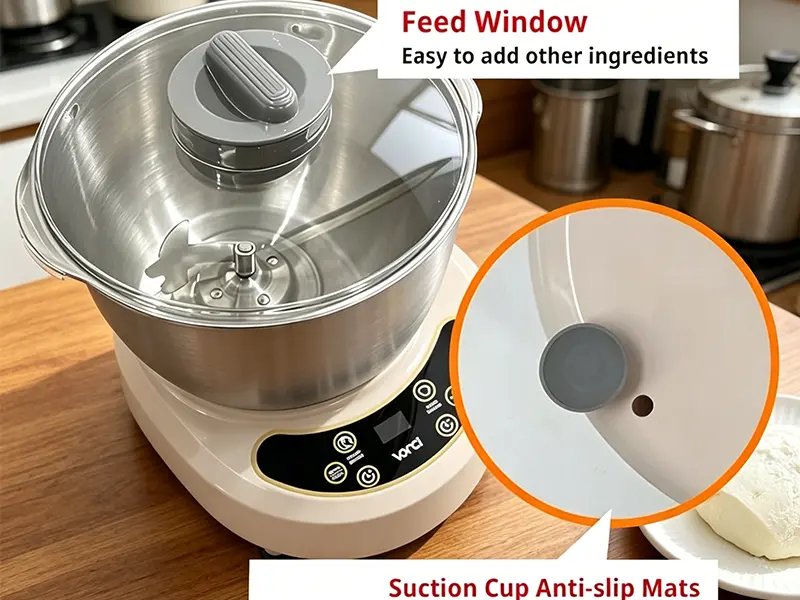
The two dominant types on the market are compact countertop stand mixers for household use and commercial dual-action, dual-speed dough mixers. Their core components include a mixing bowl, dough hook, drive motor, speed control switch, safety guard, and emergency stop button. Compared with hand kneading, dough mixers deliver precise control over mixing duration and speed, fully developing the gluten network required for bread and ensuring uniform fluffiness and pull-apart crumb texture after proofing. However, as electric food processing machinery, improper operation can lead to issues such as under-mixed dough, motor overload, abnormal equipment noise, and safety hazards resulting in injury. Therefore, mastering standardized operating procedures, routine maintenance practices, and troubleshooting skills is essential to guarantee baking quality, extend equipment service life, and ensure operational safety.
Pre-Operation Preparation for Dough Mixers
Before officially starting the equipment, three tasks must be completed: hardware inspection, ingredient preparation, and environment verification, to eliminate potential safety hazards and ensure satisfactory kneading performance.
First, full equipment inspection. Start by disconnecting the power supply and checking the power cord for damage or exposed wiring to prevent electric shock risks. Inspect the mixing bowl and dough hook for deformation or cracks, and confirm that accessory mounting bayonets move freely without jamming. Test the responsiveness of the safety guard and integrated safety switch — the vast majority of dough mixers feature a lid-open shutdown protection mechanism that prevents startup when the guard is unlatched, so proper function of this safety device must be verified. At the same time, clear any residual dry flour or old dough scraps from the mixing bowl to prevent cross-contamination between old and new dough that would impair flavor and texture.
Second, precise ingredient portioning. Weigh out high-gluten flour, ice water, yeast, fats, salt, and other ingredients according to the bread recipe. For dough mixing in baking, follow the principle of dry ingredients before wet, fat-free before fat-added. Portion ingredients in advance to avoid disorganized feeding. Ice water is preferred for summer baking to suppress dough temperature rise during mixing and prevent gluten breakdown.
Third, placement and environment setup. Position the dough mixer on a flat, non-slip, dry surface, ensure adequate clearance around the unit for heat dissipation, and keep it away from water sources and flammable materials. Operation in humid environments is prohibited. Only after all inspections are complete may the power be connected and the machine readied for startup.
Standard Operating Procedures for Dough Mixers
The dough mixing process is divided into four stages: low-speed blending, medium-speed dough formation, high-speed gluten development, and final low-speed mixing after fat addition. Opening the guard or reaching into the mixing area while the machine is running is strictly prohibited at all times. The detailed steps are as follows.
Step 1: Add dry ingredients. Close the safety guard, pour dry ingredients such as flour, yeast, and granulated sugar into the mixing bowl, select low speed (speed 1), and mix for 1–2 minutes to thoroughly combine the dry ingredients. This prevents direct contact between yeast and salt, which would deactivate the yeast.
Step 2: Add wet ingredients. Maintain the low speed setting and slowly add ice water in portions. Continue mixing for 3–4 minutes until all dry flour is incorporated and a rough, inelastic dough mass forms. Do not increase the speed at this stage to avoid flour splatter.
Step 3: Develop gluten at medium to high speed. Switch to medium speed and mix for 5–6 minutes until the dough becomes initially smooth and forms a basic gluten structure. Then switch to high speed and continue kneading for 3–5 minutes, until the dough can be stretched into a thick, pliable film — the improved (expanded) gluten stage.
Step 4: Add fat and finish mixing. Add fats such as butter or salad oil, return to low speed and mix until the fat is fully absorbed, then switch back to high speed and mix for 2 more minutes. Mixing is complete when the dough passes the windowpane test: it can be stretched into a thin, resilient membrane that does not tear easily.
Step 5: Shut down properly and remove the dough. First, dial down to low speed and bring the machine to a gradual stop. Wait until the dough hook is completely stationary, then open the safety guard and remove the dough. Wipe away any small dough residues adhering to the bowl wall to conclude the mixing cycle.
Under no circumstances should you reach into the bowl or force open the guard while the machine is in operation. Press the emergency stop button immediately if dough becomes jammed on the hook.
Routine Maintenance Specifications After Use
Timely, standardized maintenance is critical to extending the service life of a dough mixer and complying with food hygiene standards. All maintenance work must be carried out with the power disconnected and after the equipment has fully cooled down.
First, immediate cleaning. Remove the dough hook and mixing bowl, then wash them with warm water and neutral food-safe detergent. Do not use steel wool to scrub the stainless steel interior, as scratches will trap dirt and bacteria. Wipe the exterior of the machine body with a damp cloth. Never submerge the entire machine in water or allow water to enter the motor's heat dissipation vents, as this can cause electrical short circuits.
Second, component upkeep. Apply food-grade lubricating grease to the rotating shaft and bearings on a weekly basis to reduce mechanical wear during operation. Check the tightness of safety switches and locking buckles, and retighten any loose screws promptly.
Third, long-term storage maintenance. If the equipment will be unused for an extended period, thoroughly clean and dry all accessories, cover the entire unit with a dust cover, and store it in a dry, well-ventilated location. Run the machine empty at low speed for 1 minute each month to prevent rust and seizing of the motor and shaft. Fourth, load control maintenance. Do not operate the machine continuously with overloaded dough batches, as this causes the motor to run at persistently high temperatures. Allow 5 minutes of idle cooling time after each mixing cycle before starting the next batch.
Common Daily Faults and Troubleshooting Methods
Compiled below are simple, no-disassembly solutions for the most frequent faults seen in both household and commercial dough mixers. For complex electrical faults, contact professional after-sales support; unauthorized disassembly of the motor is prohibited.
Main faults and solutions:
Machine fails to start: Most often caused by an improperly latched safety guard, a faulty safety switch, a loose power connection, or activated motor overload protection. Solution: Re-secure the safety guard, check the power plug, and leave the machine powered off for 10 minutes to reset the overload protection.
Abnormal noise and severe vibration during mixing: Three common causes: the mixing bowl is not properly locked in place, the dough hook is misaligned, or the batch size is too large. Solution: Re-fasten the bowl and mixing accessories properly, and reduce the amount of dough per batch.
Uneven mixing with dry and wet separation: Usually results from starting at too high a speed or adding all ingredients at once. Solution: Resume mixing at low speed and add liquid ingredients gradually in batches to improve uniformity.
Motor overheats and shuts down rapidly: Caused by excessively long continuous runtime or overloading. Solution: Stop the machine immediately to allow cooling, shorten the duration of each continuous operation, and strictly adhere to the machine's rated dough capacity per batch.
Excessive dough sticking to the dough hook: Caused by overly high water content in the dough. Solution: Add a small amount of extra dry flour and moderately increase the mixing speed to help the dough release from the attachment.
Note: For severely damaged units or those requiring disposal, please handle them in accordance with local environmental protection policies and waste recycling regulations.
Dough mixers have a wide range of applications and can be used to mix and knead dough for all types of baked flour-based foods. Their key benefits include higher production efficiency and reduced labor burden, making them highly valuable for both home use and the catering industry.