
Core Principles of Drip-Free Design for Sauce Makers
Jul 27,2026
334
Making homemade tomato sauce, ranch dressing, and berry jams is a routine staple in Western household kitchens. The most widely criticized flaw of traditional, older-style sauce makers is dripping and stringy residue at the discharge nozzle. Owing to their viscosity and surface tension, thick sauces easily cling to surfaces and drip down, soiling countertops and wasting fresh produce. Over time, dried leftover residue can harbor bacteria, failing to meet FDA and LFGB food safety standards in North America and Europe. The new generation of household and light-commercial sauce makers addresses dripping at its source through a four-part synergistic design: physical flow guidance, sealing shut-off, negative pressure back-suction, and structural optimization. This drip-free technology features clear engineering logic and high practicality, perfectly aligning with overseas consumers’ core demands for a tidy, easy-to-clean, hygienic, and safe kitchen experience.
There are two fundamental physical causes of sauce dripping. First, sauces have inherent viscosity and surface tension; after the machine stops, residual sauce inside the discharge nozzle slowly falls under gravity, causing continuous dripping. Second, standard discharge channels use a straight, vertical structure with no shut-off sealing mechanism, so internal residual pressure continues to push sauce forward — making thick jams and creamy salad dressings especially prone to stringing and surface clinging. Drip-free designs target these two physical properties, creating a closed-loop protection system across four dimensions: discharge channel geometry, sealing valves, mechanical linkage, and auxiliary flow guidance.
First core principle: conical sealing shut-off valve for instant physical flow cutoff. This is a standard feature on mainstream electric tomato sauce makers in North America and Europe. A food-grade silicone conical sealing plug is built into the discharge nozzle, fitting precisely into a tapered groove on the spout to create a gap-free sealing surface. When the machine runs and the auger pushes sauce forward, pressure from the sauce pushes the plug open for smooth discharge. The moment the motor stops, a built-in spring rapidly retracts the plug to fully block the discharge channel and cut off internal sauce flow. Unlike ordinary flat sealing rings, the tapered bevel design scrapes off sauce clinging to the spout edge, preventing thick sauce from getting trapped in sealing gaps and dripping continuously. The entire sealing assembly is made of detachable 304 stainless steel and food-grade silicone, resistant to high temperatures and the fruit acid in tomato sauce, and compliant with Western food-contact material regulations. All parts are dishwasher-safe after disassembly. For high-viscosity sauces such as honey mustard and cheese sauce, thicker, wider silicone seals are used to prevent seepage and leakage of dense materials.
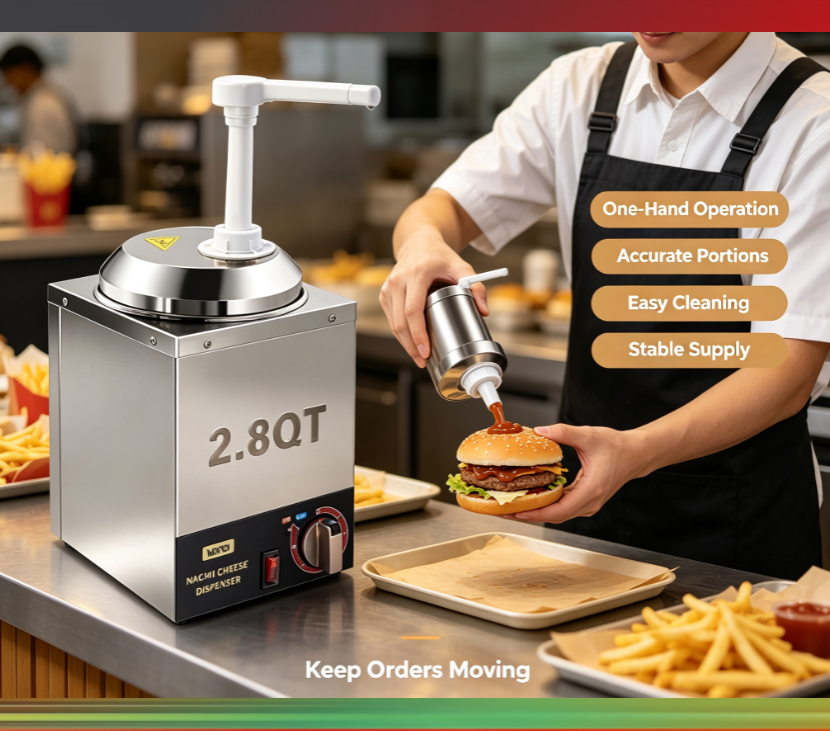
Second core principle: negative pressure back-suction technology to eliminate stringy residue at the spout. High-end commercial and large-capacity household sauce makers are equipped with an automatic back-suction mechanism, a feature overseas consumers prioritize when purchasing. Within 0.3 to 0.5 seconds after sauce discharge stops, the internal auger retracts slightly to create an instantaneous micro-negative pressure in the discharge chamber. This pulls sauce hanging at the spout tip — sauce on the verge of dripping — back into the internal hopper, completely shearing through stringy sauce and achieving a clean, residue-free stop. The back-suction stroke can be fine-tuned based on sauce viscosity: a shorter stroke for thin tomato sauce, and a longer stroke for thick berry jams and peanut butter, accommodating all types of Western cold and hot sauce preparation. This technology solves the common pain point of sauce dripping and soiling the exterior of glass jars and labels during batch home canning, greatly reducing manual cleaning effort.
Third auxiliary drip-resistant structure: angled flow-guiding discharge trough with a drip collection zone. Valve sealing alone cannot completely prevent small amounts of sauce overflow. Instead of a straight vertical discharge spout, the machine uses a 12–15° angled one-piece discharge trough. The sloped design allows flowing sauce to slide fully into the container below by gravity, without accumulating at the spout edge. The end of the trough is narrowed with a rounded lip to reduce the surface area where sauce can cling. Meanwhile, a hidden, detachable drip tray is integrated into the machine base to catch minor overflow from the sealing valve, preventing it from dripping directly onto the countertop. This design suits the open-concept kitchens common in Western households, keeping countertops clean during batch preparation of marinara and barbecue sauce without the need for extra paper towels, matching overseas users’ preference for a simple, uncluttered kitchen routine.
Fourth foundational structural optimization: seamless, dead-end-free internal flow paths to prevent internal buildup and leakage. Dripping and leakage do not only occur at the discharge nozzle; sauce residue inside the machine chamber slowly seeping through body gaps is another common risk. Premium sauce makers use a one-piece stainless steel grinding chamber with a smooth, groove-free inner wall, ensuring zero sauce stagnation during the entire conveying process. The main shaft end is fitted with multiple layers of food-grade PTFE sealing gaskets, which block sauce from seeping along the drive shaft into the motor compartment — preventing leaks while protecting the motor from sauce corrosion. Paired with interchangeable screens of various mesh sizes and a reverse-function anti-clog feature, the design avoids localized buildup and overflow caused by blockages. This reduces sauce residue throughout the entire process from feeding to discharge, lowering the risk of dripping at the source.
From the perspective of real-world use in Western markets, this multi-layer drip-proof combination design delivers exceptional practical value. For home canning enthusiasts processing dozens of pounds of tomatoes each fall to make marinara and preserved jams, it eliminates the need for frequent wiping of jar rims and countertops. For small cafes and casual eateries that continuously prepare ranch dressing, salsa, and pesto, the drip-free design keeps serving containers clean and elevates dish presentation. In addition, all detachable drip-proof components are dishwasher-safe, perfectly fitting the cleaning habits of Western households. With no hard-to-reach sanitary dead spots, the design prevents dried sauce from fostering mold growth, aligning with overseas consumers’ values of healthy eating and hygienic food handling.
Drip-free performance in sauce makers is not achieved by a single component, but by the synergy of four core mechanisms: instant flow cutoff via conical sealing valves, residue elimination via negative pressure back-suction, flow control via angled guide troughs, and buildup prevention via fully sealed internal flow paths. Together, they precisely solve the two physical challenges of thick sauces: gravity-driven dripping and surface-tension stringing. The full design addresses three core priorities of overseas users — safety, hygiene, and convenience — and represents a key technical distinction between entry-level basic sauce makers and high-end best-selling cross-border models. With its proven drip-free design, the machine significantly reduces sauce waste and cleaning burden, making it an essential kitchen appliance for Western households making homemade sauces and for small foodservice businesses preparing fresh sauces on demand.