
Don’t Panic If Your Dough Mixer Breaks! A DIY Troubleshooting Guide
May 22,2026
425
Ever splurged a few hundred bucks on a home dough mixer, excited to finally ditch the arm-numbing hand-kneading for buns and bread, ready to enjoy the freedom of hands-free baking? But then, disaster struck on the first use: the machine did nothing when you hit the power button, or it suddenly stopped mid-knead, or even let off a weird burning smell. You panicked, yanking the plug, convinced your brand-new gadget was already broken?
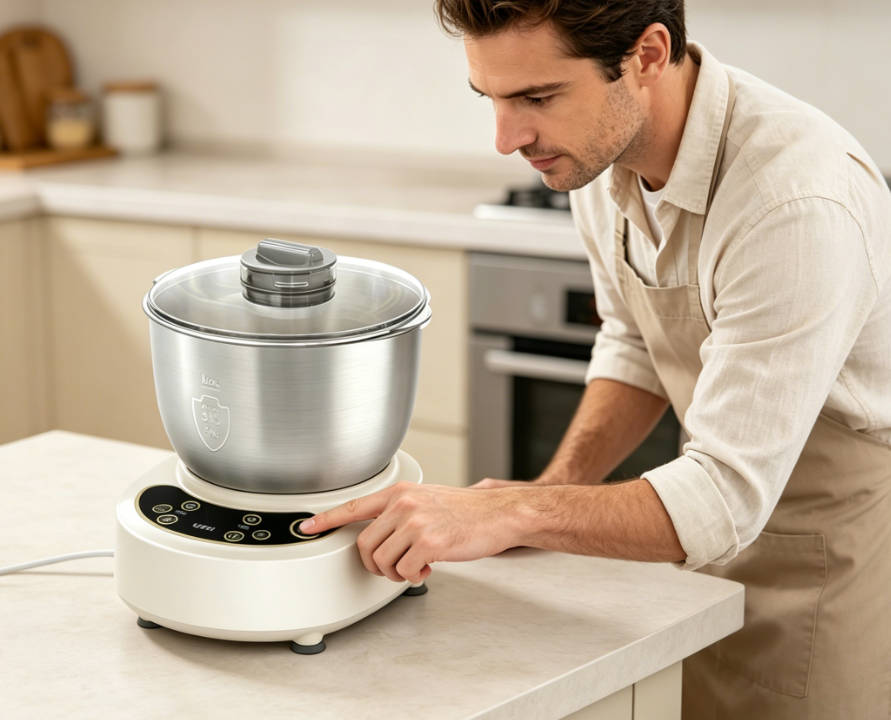
Take a breath! 90% of the small issues with home dough mixers aren’t actual breakdowns. You don’t need to take the machine apart, and you don’t need any technical know-how. Only reach out to customer service if you really can’t fix it yourself.
First rule: No matter what goes wrong, do this first!
Before you check anything else, unplug the machine immediately!
Don’t assume it’s safe just because it’s stopped, and don’t think “I’ll just take a quick look, I won’t touch the switch.” If you accidentally hit the power button with your hand inside the bowl, that’s no joke. Safety always comes first. All troubleshooting must be done with the machine unplugged—this is non-negotiable.
Troubleshooting 1: The Machine Won’t Turn On At All?
This is the most common issue: you plug it in, hit the switch, but the light doesn’t turn on, the mixing hook doesn’t move, and there’s no sound at all. Your first thought is probably “the machine is broken?”
Don’t worry, check step by step in this order, and you’ll find the problem in 10 minutes:
Step 1: Check the Power First—Don’t Let a Bad Outlet Fool You
Most of the time, it’s not the machine, it’s the power!
First, check if the plug is loose? Or did you plug it into a power strip that’s turned off? A friend of mine once spent half an hour troubleshooting her new mixer, only to realize she’d forgotten to flip the power strip’s switch. She panicked for nothing.
If the plug looks fine, plug another device—like your phone charger—into that outlet. Does it work? If not, the outlet is broken, that has nothing to do with the mixer! Just switch to a different outlet!
My neighbor Aunt Zhang made this mistake too. The old outlet in her house had a loose connection, and she thought the mixer was broken. She called customer service for ages, only to fix it instantly by switching outlets. She was so embarrassed.
Step 2: Did You Overload the Machine and Jam It?
A lot of first-time users load way too much flour, worried they won’t have enough. If the machine says max 500g of dry flour, but you poured in 1kg, the bowl gets too full, jamming the mixing hook so the motor can’t turn it, and the machine won’t start.
Unplug the machine, open the lid, and gently nudge the mixing hook with your hand or a chopstick. Can it move? If not, it’s jammed!
It’s an easy fix: just scoop out half a bowl of the extra flour, don’t fill it that full, and try again. It’ll work right away! My neighbor Sister Li had this exact problem. She filled the whole bowl with flour for her first batch of buns, and when the machine wouldn’t start, she wanted to return it. Once she scooped out half, it worked perfectly. She ended up kneading that extra half bowl in two separate batches, no problem.
Step 3: Is the Machine Overheated?
If you’ve already kneaded several batches of dough, or you’ve been kneading really hard dough for a long time, the motor can get too hot. When that happens, it triggers its own safety feature—it temporarily cuts power to keep from burning out.
It’s just like your phone: when you play on it too long, it gets hot and slows down to cool off. Machines need breaks too!
In this case, don’t do anything. Unplug it, open the lid, and let it cool down for half an hour. Then plug it back in and try again. Most of the time, it works! This isn’t a breakdown—it’s just the machine being too tired. Give it a rest, and it’ll be good as new.
Step 4: Did You Forget to Lock the Lid? This Trips Up So Many New Users
A lot of dough mixers have a safety lock: if the lid isn’t clicked shut properly, the machine won’t start, to keep you from sticking your hand in and getting hurt!
So many people leave the lid loose, hit the switch, and think the machine is broken. Check your machine—does the lid have a small latch? Push it down until you hear a “click”, then try the power button again. It’ll probably work! I’ve seen so many new users fall for this one, over and over.
Troubleshooting 2: The Machine Spins, But It Can’t Knead the Dough, and the Dough Stays Lumpy?
Some people say the machine spins, but it spins really slowly. After 10 minutes of kneading, the dough is still in chunks, not smooth, and the mixing hook can’t even pull the dough. What’s going on?
Step 1: Did You Add Too Little Water, Making the Dough Too Hard?
This is the most common issue! A lot of people skimp on water when kneading. For example, for buns, 500g of flour needs at least around 250ml of water—that’s about half the weight of the flour. If you only added 200ml, the dough will be as hard as a rock, and of course the machine can’t knead it!
You can stop the machine, and slowly add a little warm water. Don’t add too much at once, add it bit by bit, stir after each addition, and check if the dough softens up enough to knead.
I had a follower once who was making bread, added too little water, and kneaded for 20 minutes with the dough still falling apart. She thought the machine was broken, but once she added a bit more water, she got proper gluten development in 5 minutes. She laughed at herself afterward, saying it wasn’t the machine’s fault, it was her skimping on water.
Step 2: Did You Install the Mixing Hook Wrong?
A lot of people don’t lock the hook in place properly, or install it backwards. That means the hook doesn’t reach the bottom of the bowl, so it can’t pull the dough with it, or it just spins empty.
Unplug the machine, pull the hook out, and reinstall it. Usually, you’ll hear a “click” when it’s locked into place. Don’t leave it loose!
Troubleshooting 3: The Machine Is Super Loud and Wobbling All Over? It’s Not Breaking—It’s Just Not Set Up Right
As soon as you turn it on, the machine buzzes so loud it sounds like a drill, and the whole thing wobbles around. You panic, thinking it’s going to explode?
Don’t worry, most of the time it’s a small issue:
Step 1: Is It Sitting Level?
Where did you put the machine? Is the table lopsided? Or is one of the machine’s four feet not touching the table, hanging in the air?
Wiggle the machine with your hand. If the machine itself wobbles, that means it’s not level! Grab a paper towel, fold it up, and stick it under that empty foot to level it out. Instantly, it’ll stop wobbling, and the noise will go down!
So many people ignore this. If the machine isn’t level, the spinning throws off the balance, so it wobbles and makes noise. A little shim fixes it—you can use a paper towel, a hard card, anything you have at home.
Step 2: Is There Something Hard in the Dough?
Did you accidentally drop an eggshell into the dough while kneading? Or are there hard lumps in the flour? Or even ice cubes you added? Those hard things will bump against the bowl as it spins, making noise. Just open the lid and pick them out!
Troubleshooting 4: There’s a Burning Smell or Smoke Mid-Knead? Unplug First, Don’t Panic
This is the scariest one. A lot of people see smoke and think it’s going to catch fire, but most of the time it’s not a big problem:
Step 1: Is It Jammed?
If you put too much dough in and jammed the machine, the motor can’t spin, so it strains itself, heats up, and gives off a burning smell, even smoke. In this case, unplug it right away, don’t let it keep straining. Then scoop out some of the extra dough, let it cool for half an hour, and try again. As long as the motor didn’t burn out, it’ll work once it’s cool.
Step 2: Is It the Break-In Smell for a New Machine?
A lot of new machines, when you use them for the first time, the protective oil on the motor, or the plastic parts, can let off a slight smell when they heat up for the first time. It goes away after 1 or 2 uses. This is totally normal, it’s not a breakdown, and it’s not toxic. Don’t worry about it.
If you do all this, and you still have a burning smell, smoke, and it doesn’t work after cooling down, then it’s time to call customer service. Don’t try to fix it yourself.
Troubleshooting 5: The Bottom of the Bowl Is Leaking Dough Batter or Oil? Is the Machine Broken?
A lot of people finish kneading, and notice thin dough batter leaking from the bottom of the bowl, even some sticky stuff. They panic, thinking the machine is leaking oil, and the dough is unsafe to eat?
Don’t scare yourself. Most of the time, it’s just dough batter leaking:
Step 1: Is Your Dough Too Runny?
If you’re making a really thin batter, like cake batter, it can leak a little through the gap at the bottom of the bowl. This is normal! The seal ring is made to keep dry dough in, but really runny batter can seep out a bit. Next time you make thin batter, just don’t fill the bowl that full, and it’ll be fine.
Step 2: Did You Install the Seal Ring Wrong?
There’s a small black rubber ring at the bottom of the bowl—that’s the seal. A lot of people accidentally knock it off when washing, or install it crookedly, and that causes leaks!
Unplug the machine, take the bowl out, and check that small rubber ring at the bottom. Did it fall off? Put it back in, make sure it’s level, and it won’t leak anymore! That ring is easy to knock loose, so many people don’t notice it when they wash the bowl.
If it’s black, greasy lubricant that’s leaking, then that’s a problem with the machine. Stop using it and call customer service. But 90% of the time, it’s just dough batter leaking, not oil.
Troubleshooting 6: The Mixing Hook Is Stuck to the Dough, You Can’t Pull It Out?
After kneading, you try to take out the mixing hook, but it’s stuck to the dough, you pull and pull and can’t get it out, getting dough everywhere?
It’s so simple! Soak the hook and the attached dough in water for 5 minutes. Once the dough softens, you can pull it right out. Or, right after you finish kneading, while the dough is still warm, gently wiggle the hook, and it’ll come loose. Don’t yank it hard—you could break the hook!
Do This for Regular Maintenance, and You’ll Avoid 90% of Issues
Actually, most breakdowns are caused by improper use. If you follow these tips, you’ll have way fewer problems:
1. Don’t overload it: Don’t exceed the machine’s maximum capacity. If it’s a 500g machine, don’t put in 600g of flour. Overloading not only makes it unable to knead, it also damages the motor.
2. Clean it right away: Wash it as soon as you’re done using it. Don’t let the dough dry out inside—it’s hard to clean once it’s dry, and it can jam the machine. Don’t use a steel wool scrubber, just use a sponge.
3. Don’t run it empty: Don’t let the machine spin with nothing in it. Running the mixing hook empty wears it out easily.
4. Don’t knead things that are too hard: Don’t use it to knead extra-hard noodle dough, or add lots of nuts or ice cubes. The machine can’t handle things that are too hard, and it can break.
For These Issues, Don’t Fix It Yourself—Call Customer Service Right Away
Not every problem can be fixed at home. If you run into these, don’t mess around, call a professional:
1. After unplugging and cooling for half an hour, it still won’t turn on, and it trips the circuit breaker as soon as you plug it in;
2. It’s leaking black, greasy lubricant, not dough batter;
3. The motor smoked, and after cooling, it still has a burning smell and won’t spin;
4. The machine’s shell is cracked, or the mixing hook broke;
5. If the machine is still under warranty, just call customer service! Don’t take it apart yourself—if you do, you’ll void the warranty!
At the end of the day, home dough mixers aren’t that fragile. They’re not some high-tech, precision machine. Most of the small issues are just from us not paying attention when we use them, not the machine breaking down.