
Do you think the dough mixer runs too slowly?
May 26,2026
356
Have you ever watched the mixing bowl of a dough mixer, seeing the dough hook rotate at a leisurely pace, and felt so impatient that you wanted to give it a push by hand? You are not alone, but you are mistaken.
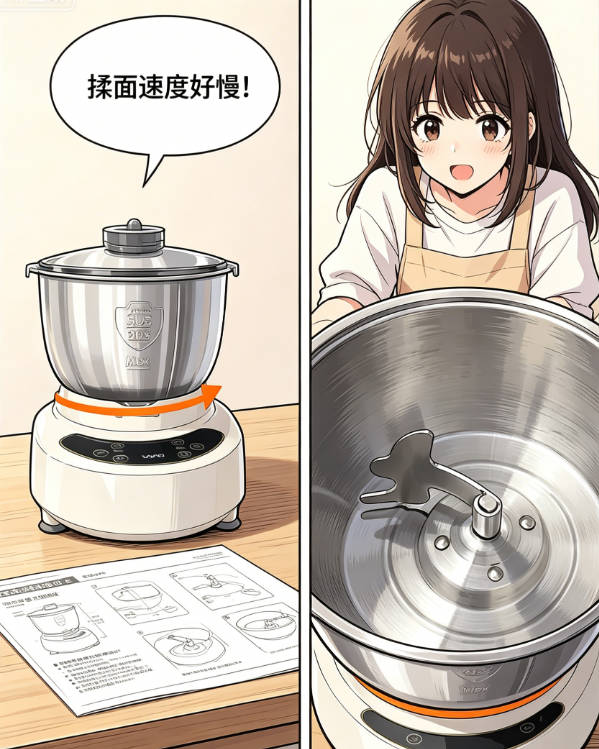
I will illustrate with three solid reasons:
The low speed of a dough mixer is not idling, but a way to protect your dough.
If you blindly chase a faster speed, it is not the machine that fails, but that you have not yet understood the physical properties of dough.
1. Why can't dough mixers spin at high speed like blenders?
A comparative experiment was conducted:
Group A: The dough mixer kneaded dough at the regular speed (about 60-80 revolutions per minute) for 12 minutes.
Group B: The dough was kneaded for 6 minutes at the maximum speed of the stand mixer (about 200 revolutions per minute).
The results were unexpected:
The dough in Group A had a complete gluten network and good elasticity, and the finished bread reached a height of 12 cm after baking.
The dough in Group B looked smooth on the surface, yet its internal gluten was severely broken. The baked bread was only 7 cm tall and tasted like steamed sponge cake.
Why is this the case?
Because gluten does not become stronger with excessive kneading. It develops best when stretched gently and rhythmically.
High-speed rotation generates shear force, which cuts the newly formed gluten molecular chains apart just like a pair of scissors.
The faster you knead, the more damaged the gluten becomes.
Kneading dough at high speed is just like asking a strongman to do the job. He will tear the dough apart in a hurry and then claim the dough is of poor quality.
2. Three overlooked benefits of low-speed kneading
2.1 Low speed allows sufficient time for water to penetrate flour particles
Do you think kneading dough is simply stirring?
That is wrong! The first step of dough kneading is hydration.
Flour particles have a multi-layer structure, and it takes 10 to 15 minutes for water to seep into the core of the particles.
If you use the high-speed setting, water will be flung onto the bowl wall before it can fully penetrate.
The result is dough that is wet on the outside but dry inside, leading to undercooked baked goods in the end.
Low-speed kneading gives water enough time to fully blend with flour.
2.2 Low speed prevents gluten from being damaged by excessive heat
Friction between the rotating dough hook and the dough generates heat during operation.
When the rotating speed doubles, the frictional heat increases fourfold.
Once the dough temperature exceeds 28°C, gluten protein will denature, turning soft, sticky and inelastic.
Kneading at high speed for 6 minutes may push the dough temperature from 22°C up to 32°C directly.
By contrast, kneading at low speed for 12 minutes only raises the temperature to 25°C.
Low speed keeps the dough at a proper temperature.
2.3 Low speed lets you judge the dough state by sound
You can tell the dough's condition from the sounds the mixer makes:
Stage one: The dough hits the bowl wall with loose, irregular sounds.
Stage two: The sound turns dull and rhythmic.
Stage three: A soft, smooth beating sound can be heard.
These subtle sound changes can only be distinguished at medium and low speeds.
At high speed, you will only hear the constant hum of the motor, with no way to tell which stage the dough has reached.
Low speed acts as a bridge for you to monitor the dough.
3. Why hand kneading can be fast while machine kneading must be slow
Here lies a commonly ignored difference:
Your palms are soft, warm and flexible when kneading by hand, allowing you to adjust angles freely.
You push, fold and slap the dough along the direction of gluten strands instead of cutting them.
The metal dough hook of a mixer is rigid and fixed.
When rotating at high speed, it acts like a blunt knife, continuously cutting through the dough.
This explains why hand kneading can be done relatively quickly — some people can even form a thin gluten film within 10 minutes.
Yet for machine kneading, higher speed always leads to worse results.
It is not that mixers are inferior to hands, but that metal cannot replicate the flexibility of human hands.
4. Three common operational mistakes that make people feel the mixer is too slow
If you truly think your dough mixer runs unbearably slowly, check if you have made the following three mistakes:
Mistake 1: Insufficient water
Overly dry dough creates excessive friction and hinders the mixer's rotation, making it seem slow.
Solution: Add water strictly following the recipe. If large dry flour lumps remain after 3 minutes of kneading, spray in an additional 5 to 10 grams of water.
Mistake 2: Exceeding the maximum dough capacity
For example, if the machine is rated for 500 grams of dry flour, do not put in 600 grams.
An overfilled bowl will leave no room for the dough hook to rotate freely.
Solution: Always follow the maximum capacity stated in the user manual. Divide the ingredients into two batches if needed.
Mistake 3: Using the wrong speed gear
Many dough mixers have two gears: low speed and high speed.
Always use the low-speed gear for dough kneading.
The high-speed gear is only for whipping egg whites or cream; some machines are not even designed for prolonged high-speed operation.
Solution: Refer to the user manual to confirm the dedicated gear for dough kneading and do not use gears arbitrarily.
5. Effects of different rotating speeds on dough (Scientific Data)
| Rotating Speed | Application Scenario | Impact on Dough |
| 40-60 RPM | Initial mixing and hydration | Favorable: Water fully penetrates flour particles |
| 60-80 RPM | Gluten development and maturation | Favorable: Gentle stretching maintains intact gluten |
| 100-120 RPM | Not suitable for dough kneading | Unfavorable: Shear force starts to damage gluten |
| Above 120 RPM | Prohibited for dough kneading | Very unfavorable: Gluten breaks and dough temperature rises sharply |
Next time you feel the mixer is slow, check if it is running within the optimal kneading range of 60 to 80 RPM.
6. Why professional low-speed mixers are usually more expensive
Here is a little-known fact:
Professional dough mixers, such as high-end commercial spiral mixers costing over a thousand yuan, generally run at lower speeds.
They are designed to simulate the pushing and folding motions of hand kneading with high torque and low rotating speed.
In contrast, mixers with impressive high-speed performance are mostly multi-functional household models, which are not professionally optimized for dough kneading.
If you want to improve kneading efficiency instead of buying a faster machine, you may try the following methods:
Adopt the hydration rest method: Mix flour and water first, let the mixture stand for 30 minutes, then start the mixer. This can cut kneading time by half.
Use warm water: Water at 30°C (not boiling water) can speed up the hydration process.
Add 5% rice flour or vital wheat gluten: This helps optimize gluten formation efficiency.
The low running speed is not a defect of dough mixers. The speed of household dough mixers is professionally tested and calibrated to deliver optimal kneading results.