
How Many Decibels Do Quiet Blender Models Reach?
May 07,2026
4463
Blenders are widely used in daily life worldwide, yet they have an obvious pain point: loud operating noise. This has become a key selling point for many merchants. Noise levels of many standard models hit 80-90 decibels, nearly as loud as a power drill. Many people worry about waking family when making soybean milk in the early morning or disturbing neighbors when preparing baby food at night. Noise has long compromised the user experience. With the iteration of noise reduction technology, the VONCI quiet blender has emerged. Its decibel level, noise reduction principles and real-world performance have become core considerations for consumers when making a purchase.
I. Blender Noise Benchmark: Decibel Gap Between Standard and Quiet Models
To understand the noise level of quiet blenders, decibel (dB) is the unit for measuring sound intensity. The higher the value, the harsher the sound and the greater the disturbance to people.
The noise range of ordinary non-quiet blenders is mainly 75-90 decibels. Equipped with traditional brushed motors and lacking dedicated noise reduction structures, these models produce combined noise from motor friction, blade stirring ingredients and body vibration during high-speed operation. The sound is comparable to busy street traffic or power drill construction, easily disturbing others when used early morning or late at night.
Daily conversation registers around 60 dB, and a quiet library environment is about 40 dB. It is clear that standard blenders far exceed the comfortable noise threshold for daily life.
In contrast, mainstream quiet blenders operate at 37-50 decibels, with premium models dropping to 34-38 decibels — close to the noise level of a library or soft conversation, achieving the core goal of noise-free use. The industry generally defines a quiet blender as one with operating noise ≤50 dB, and ultra-quiet models ≤40 dB. This decibel range balances blending efficiency and suitability for scenarios such as early morning and late-night use.
The actual auditory difference across decibel levels is notable: 34-38 dB is a "whisper-quiet level" with almost no harsh sound, quiet enough not to wake sleeping babies; 39-45 dB is a "low-noise level" with soft sound that does not interrupt normal conversation; 46-50 dB is an "entry-level quiet level" with deep, muted noise that won’t travel to the living room or bedroom when used inside a closed kitchen.
II. Core Decibel Range of Quiet Blenders & Actual Test Data of Mainstream Models
Most mainstream quiet blenders on the market are labeled with phrases like "Low Noise 37dB" and "Quiet 38dB". Note that official labeled decibels are mostly laboratory data under specific conditions (no load, low-speed mode); actual noise rises by 3-5 dB under load (blending soybean milk, nuts). Below is a reference of official labeled and real tested decibel levels for mainstream industry models:
(1) Ultra-Quiet Models (34-38 dB)
Mijia Smart Low-Noise Variable Frequency Blender P1: Officially rated 37dB. Equipped with a variable-frequency brushless motor and fully enclosed sound insulation cover. Real test: 39-41dB in soybean milk mode. Compact body, ideal for small households.
Joyoung Variable Frequency Low-Noise Blender B6: Officially as low as 38dB. Adopts variable-frequency brushless motor and recessed shock-absorbing base. Real test: around 40dB in grain mode with deep, non-harsh noise.
Daewoo Soundproof Space Capsule Blender: Industry benchmark for ultra-quiet performance, officially 34dB. Features hollow sound insulation structure and magnetic levitation shock absorption. Real test: 36-38dB under load, perfect for households extremely sensitive to noise.
(2) Mid-Range Quiet Models (39-45 dB)
Midea Sleep-Proof 3.0 Variable Frequency Blender: Officially ≤38dB. Built with 10-layer noise reduction system and double-layer soundproof cup. Real test: 42-44dB in soybean milk mode, balancing quiet performance and fine blending texture.
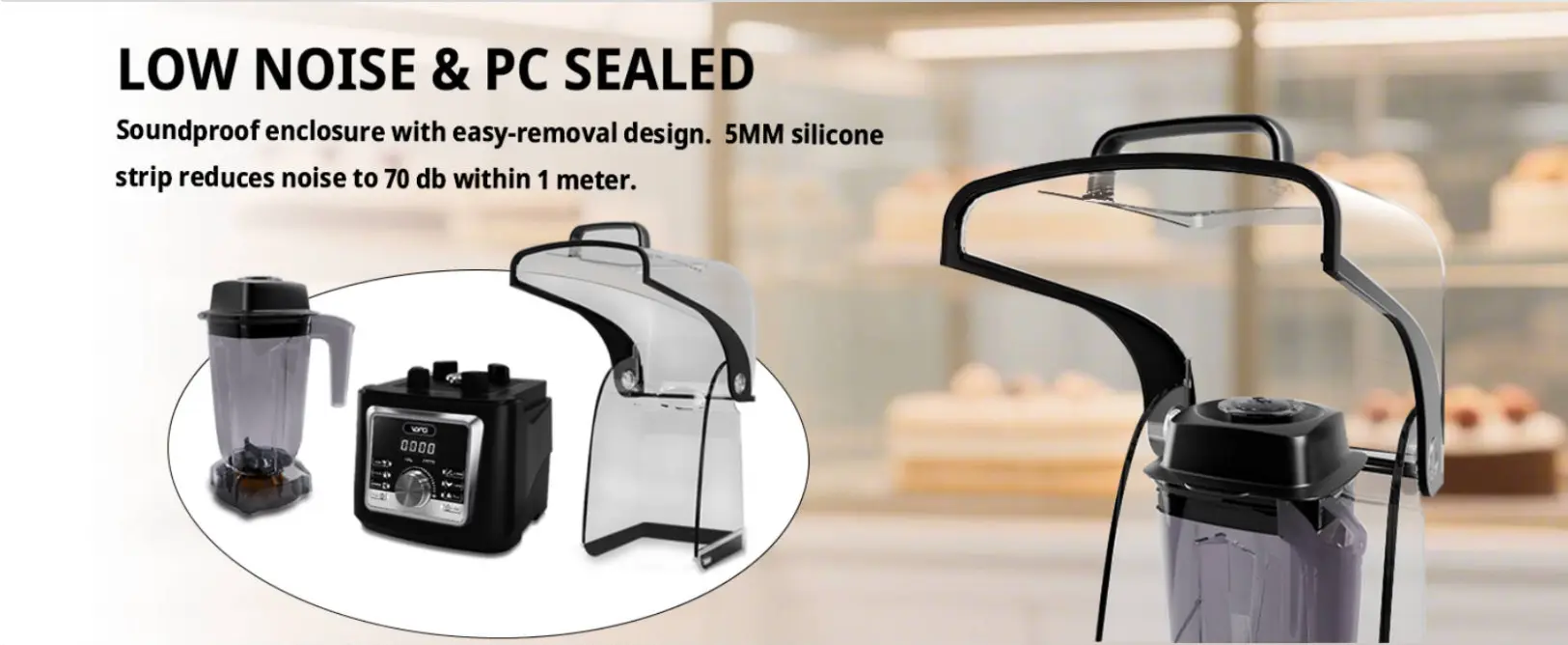
VONCI Blender with Sound Insulation Cover: Officially 44dB. Features sound insulation design and 3-blade head. Real test: around 43dB in baby food mode with high cost performance.
(3) Entry-Level Quiet Models (46-50 dB)
Joyoung L18-1P165 Blender: Officially 53dB. Lightweight body with basic sound insulation structure. Real test: 48-50dB in daily mode. Meets basic quiet needs at an affordable price.
Overall, a truly practical quiet blender maintains a stable noise level of 40-45 dB under daily load operation, with no obvious harsh sound and no excessive budget required. For ultimate quiet performance, choose 37-40dB models; for budget-limited users, 46-50dB models can also greatly reduce noise disturbance.
III. Core Technology Behind Blender Quiet Performance: Reducing Decibels at the Source
The ability of quiet blenders to control noise within 50dB relies not on a single technology, but the combined effect of motor innovation, structural noise reduction and material shock absorption. It lowers noise layer by layer from three dimensions: noise generation, transmission and vibration.
(1) Motor Upgrade: Cutting Noise at the Source (8-10dB Noise Reduction)
Traditional blenders use brushed motors. High-frequency noise generated by friction between carbon brushes and rotors during operation is the main noise source. Quiet models are fully equipped with BLDC variable-frequency brushless motors. Removing the carbon brush structure and adopting electromagnetic drive eliminates friction noise at the source. Meanwhile, variable frequency technology automatically adjusts rotation speed based on ingredient hardness to avoid instantaneous loud noise impact. Compared with brushed motors, brushless motors reduce noise by 8-10dB, while offering longer service life and lower energy consumption — becoming a standard core configuration for quiet blenders.
(2) Structural Noise Reduction: Blocking Noise Transmission (10-15dB Noise Reduction)
After noise is generated, structural design is used to block transmission paths. Main solutions include:
Fully Enclosed Sound Insulation Cover: Double or triple composite structure (borosilicate glass + sound insulation cotton + sound blocking shell) wraps the cup and blade head to block airflow noise from blade stirring, equivalent to putting a "mask" on the noise;
Recessed Base + Shock-Absorbing Foot Pads: Built-in recessed motor paired with silicone shock-absorbing foot pads reduces vibration transmission between the blender body and countertop, preventing vibration from amplifying noise;
Soundproof Air Duct Design: Optimizes airflow paths inside the cup to reduce turbulent noise during high-speed blending and avoid sharp howling sounds.
(3) Load Optimization: Lowering Noise From Ingredient Stirring
Noise generated by blades stirring ingredients accounts for about 30% of total noise. Quiet models adopt 6-blade / 8-blade obtuse-angle blade heads to replace traditional sharp blades, reducing impact noise from ingredients. Optimized cup radian also enables smoother ingredient circulation and avoids harsh noise caused by localized stirring.
IV. Industry Noise Standards: Compliance Bottom Line for Quiet Blenders
There are currently no dedicated mandatory quiet standards for blenders, but they must comply with general kitchen appliance standards including GB 4706.1 and GB 19606, which stipulate normal operating noise of blenders shall not exceed 85dB (A-weighted) — the basic compliance threshold.
The industry group standard T/CNLIC 0019—2021 sets further refinement: green-design blenders must have noise ≤75dB. The industry recognized quiet classification standards are as follows:
Level 1 Quiet: ≤40dB (ultra-quiet, suitable for use near maternity rooms and bedrooms);
Level 2 Quiet: 41-50dB (premium quiet, adaptable to most daily scenarios);
Level 3 Quiet: 51-60dB (entry-level quiet, significantly quieter than standard models).
Beware of industry irregularities: some brands falsely label decibels by using no-load low-speed data as daily load noise levels. When purchasing, prioritize checking third-party test reports to verify actual tested decibels under load modes (soybean milk, hard ingredients) instead of only relying on official marketing claims.
V. Buying a Quiet Blender: Beyond Decibels, These 3 Points Matter More
(1) Prioritize 40-45dB Models to Balance Quiet Performance and Efficiency
Ultra-quiet models below 38dB usually cost over 1,000 currency units. Some even reduce blending power for noise reduction, resulting in poor blending fineness. Mid-range 40-45dB models feature mature technology at a price range of 500-800 currency units, delivering quiet performance, residue-free soybean milk and smooth baby food with the best cost performance.
(2) Verify Core Noise Reduction Configurations to Avoid "Fake Quiet" Models
Avoid fake quiet models that only rely on thickened outer shells. Prioritize products fully equipped with three core configurations: brushless variable-frequency motor + double-layer sound insulation cover + shock-absorbing base, all of which are indispensable.
Mainstream quiet blenders operate at 37-50 decibels, with premium models stable at 40-45dB and ultra-quiet models as low as 34-38dB. They completely solve the noise nuisance issue of traditional models. Their quiet effect comes from the synergy of brushless variable-frequency motors, fully enclosed sound insulation structures and shock absorption designs, rather than simple thickened outer shells.
There is no need to blindly pursue the lowest decibel level when purchasing. For example, the VONCI blender keeps noise below 70dB with full-spec configurations, ideal for users pursuing high power output.
For household use, any blender below 70dB is acceptable. Even commercial blenders often operate above 70dB. Beyond cost performance, there is no absolute "best" option — different brands each have their own advantages.